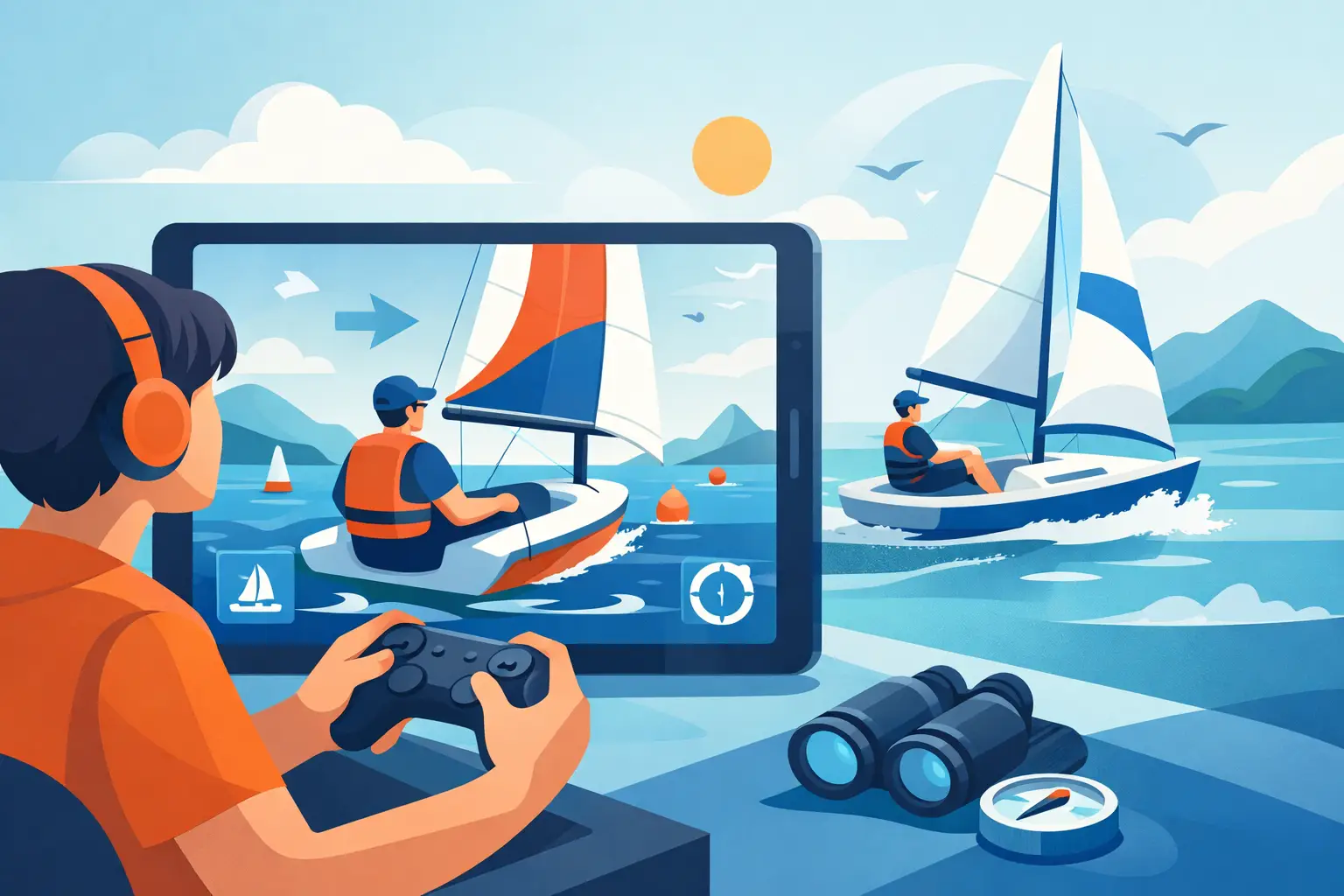
You point the boat toward the mark, feel the gust hit, and realize the sail has filled up too much. You ease off the sheet a little, the hull heels over less, and the speed picks up again. It’s in this cycle of observing, adjusting, and testing that the digital candle It's no longer just a game; it becomes a practical way to start understanding navigation.
To many people, sailing seems like a distant sport. There’s the club, the boat, the equipment, the need for someone experienced on board, and the logistics of finding wind and water. All of this is part of the real experience and has its value. But it doesn’t have to be the only way in for those who want to learn how a sailboat moves.
In a browser-based simulation, you can hit the water in minutes—on your phone, tablet, or computer. No installation, no mandatory registration, and no need to memorize a nautical dictionary before your first outing. The goal is simple: steer the boat, adjust the sails, and watch the results unfold on the screen.
What a digital candle really teaches us
Sailing isn't controlled by a single command. The boat moves forward because the course, wind strength, sail angle, and rudder position all work together. When one of these factors changes, the others must adjust accordingly. This interplay is at the heart of a good simulation experience.
Learning begins with the most visible effect: the sail must be at the right angle to the wind. If it’s too tight on a broad reach, the boat slows down and heels unnecessarily. If it’s too loose when it could be generating fclose-hauled, it loses speed. You don’t have to accept this as an abstract rule. Just experiment: trim it tighter, ease it out, change course, and compare the results.
Physics also provides context for nautical terms. The mainsail controls much of the boat’s balance and power. The genoa helps build speed, especially when the wind is coming from a favorable direction. The rudder changes the boat’s course, but a sudden turn can cost precious meters. When the hull heels over, you realize that sailing fast doesn’t simply mean pushing everything to the limit.
This cause-and-effect relationship is useful for beginners because it turns every mistake into a learning opportunity. Did you lose speed? Maybe the apparent wind changed as you turned. Did you overshoot the mark? Maybe you started the turn too late or kept too much power on the approach. Instead of memorizing answers, you start reading the signs.
Vento Realista Changes Its Decision
A sailing simulator is only interesting when the wind isn't static. A steady wind is great for learning your first tacks and figuring out where the boat performs best. Then come the gusts and roll, which really demand your attention.
A gust increases the fclose-hauled on the sails. If you keep the same trim, the boat may heel too much and become difficult to control. Sometimes, easing off the sail at the right moment is faster than pushing for speed. Other times, it’s worth accepting a bit of heel to gain ground before the next mark. It depends on the course, the wind strength, and the space you have in the race.
Tacking is even more strategic. When the wind shifts direction, a leg that seemed ideal can lose its advantage. In a headwind, small changes in course show why sailors don’t just sail in a straight line to the mark. They choose tacks, observe what the wind has to offer, and protect their position against those coming up close.
The apparent wind This completes the puzzle. It is the wind that the boat actually feels as it moves. As you accelerate, the perceived direction and intensity change. That’s why a sail that’s properly trimmed at low speeds may need to be adjusted when the boat picks up speed. It’s a technical concept, but it becomes intuitive once you feel the effect while sailing.
Start by not trying to do everything at once
Your first sailing trip is most rewarding when you have a short mission. Choose a course, keep the boat steady, and watch the sail. Then make a slight change in direction and see how the pressure changes. Only then should you start testing different settings more deliberately.
During a free training session, it’s worth repeating the same stretch a few times. Sail with the sail more trimmed, then more slack, and compare the speed and heel. Perform one gentle tack and one aggressive one. The difference is evident not only in the time it takes, but also in how well you control the boat after the maneuver.
Once you understand these basics, mark a point along the course. The approach teaches you to anticipate: you don’t want to arrive too quickly and overshoot the mark, nor do you want to arrive too slowly, with no pressure on the sail. Choosing the right moment to turn and preparing to exit the maneuver are decisions that a sail can help you visualize.
There’s no magic setting that works in every situation. When sailing upwind, you aim to make headway against the wind without losing speed. When sailing broad reach or downwind, it’s a different story: the boat requires a different sail angle, and the priority may be to maintain momentum and take advantage of every gust. That’s why experimenting is more valuable than simply copying a setting without understanding why it works.
Digital regattas put pressure on the maneuvers
Training alone helps build coordination. Racing in a regatta shows you what happens when the clock, the marks, and other boats come into play. A well-executed start can open up space. Choosing the right side at the right moment can make up for a less-than-perfect maneuver. And a small distraction near a mark can cost you positions.
The timed races Swimming against bots is a good bridge between training and competition. You test your pace, learn to handle the pressure of a timer, and discover where you’re losing time. It’s not enough to just swim well in open water. You have to think about the next leg, reaching the turn, and the margin you have to correct a mistake.
In live multiplayer, reading the race takes on another dimension. Your friends also want the same wind band, the same good start, and the best side of the lane. The strategy goes beyond simply asking, “Which course is fastest?” and comes to include questions like, “Where is there space?”, “Who’s covering my side?”, and “Is it worth going for a gust or defending my position?”
That’s where the digital candle becomes social without losing its depth. A shareable link is all it takes to call the class, set up a rematch, and see who holds the lead right up to the finish line. The competition makes you want to do it again, and repetition is a tough teacher for any maneuver.
Where simulation helps—and where it is no substitute for water
A platform like VelejAÍ breaks down major barriers: you can practice at any time, make mistakes without physical risk, and repeat a scenario as many times as you want. For those who have never been on a sailboat, this helps you build a skill set before your first lesson. For those who already sail, it serves as a quick way to practice reading the wind, trimming the sails, and strategizing between outings.
Even so, a simulation cannot replace all the elements of actual sailing. On the water, there are waves, currents, noise, body balance, communication with the crew, safety, and other variables that no digital environment can fully replicate. Learning safety procedures and sailing with proper guidance remains essential when it’s time to set sail.
The best comparison isn’t between a game and a boat, as if one ruled out the other. Simulation is an accessible training ground. It prepares your eye so that, when you feel a real gust of wind or hear someone ask the skipper to ease off, you already have a frame of reference for what to look for and why.
Quick Questions Before the First Race
Do I need to know the names of all the parts of the sailboat?
No. You can start with the controls and learn the names as you use them. The mainsail, jib, rudder, course, and heel all start to make sense when each adjustment produces a clear reaction in the boat.
Can I play it on my phone?
Yes. The idea behind a browser-based experience is to let you log in from whatever device you have on hand. On a larger screen, it may be easier to keep track of data and scores; on a cell phone, the convenience of quickly starting a game makes all the difference.
Can people who already sail take advantage of this?
It can, especially for practicing decision-making. The simulation doesn't replicate every sensation of being on deck, but it brings wind, trim, maneuvers, and racing choices to life. This makes the training useful for anyone who wants to keep their nautical reasoning sharp.
Sailing begins when you realize that you’re not just steering a boat forward. You’re having a conversation with the wind with every meter. Adjust the sails, accept an imperfect maneuver, try again, and carry that curiosity into the next race.